
Sovereignty Is Not a Yes or No Question
Most governments debate digital sovereignty as though there were only two answers: own everything or surrender control. G4I 2026 offered a more useful way to think and a framework you can use.
Ask a room of public officials whether their government has digital sovereignty and you will get an uncomfortable silence. Not because the answer is no, but because nobody is quite sure what the question means.
The debate tends to collapse into a binary. Either a country builds and operates its own technology stack (its own hardware, its own models, its own cloud) or it is dependent, compromised, and at the mercy of foreign platforms. Framed in that way, the answer for almost every government is depressing and the conversation ends there.
Across three days at the GovTech 4 Impact World Congress in Madrid, speakers kept dismantling that framing. Digital sovereignty surfaced in the AI sessions, the digital identity panel, the Beyond Legacy discussion, and a dedicated session on sovereign digital workplaces. And each time, the most useful contributions moved the conversation away from ownership and toward control.
The reframing. The Congress challenged the idea that digital sovereignty is an all-or-nothing choice. Instead, sovereignty emerged as a continuum: a series of deliberate decisions across governance, infrastructure, procurement, data, and technology that determine how much control a government retains over its digital future.
That shift changes the conversation. Sovereignty is not something a government simply has or lacks. It exists in degrees, across different layers of the digital ecosystem, and can be strengthened, or weakened, through everyday policy and procurement decisions.
Where sovereignty is won or lost. The discussions highlighted that the greatest risks to sovereignty are often not technical but organizational. Decisions about interoperability, procurement, governance, data stewardship, and internal capability ultimately determine whether governments remain adaptable or become locked into dependencies.
Rather than asking whether complete digital independence is possible, the more useful question is: where should governments choose to retain control, and where is strategic dependence acceptable?
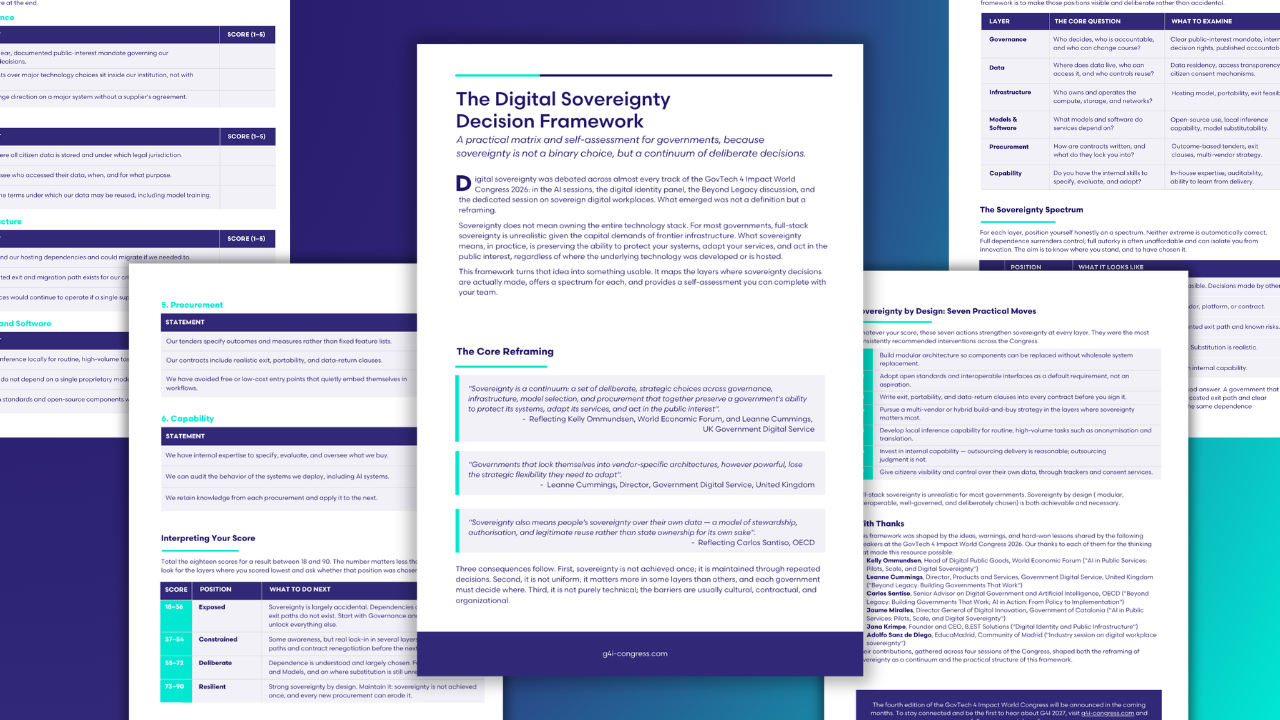
To make that question practical, we’ve translated the Congress discussions into a Digital Sovereignty Decision Framework. It maps the six layers where sovereignty decisions are made, provides a five-level maturity spectrum, and includes an 18-question self-assessment that helps governments evaluate their current position and identify their next steps.
Download the Digital Sovereignty Decision Framework to explore the complete model, practical assessment tool, and real-world examples that informed it.
With Thanks
This framework was shaped by the ideas, warnings, and hard-won lessons shared by the following speakers at the GovTech 4 Impact World Congress 2026. Our thanks to each of them for the thinking that made this resource possible:
- Kelly Ommundsen, Head of Digital Public Goods, World Economic Forum (“AI in Public Services: Pilots, Scale, and Digital Sovereignty”)
- Leanne Cummings, Director, Products and Services, Government Digital Service, United Kingdom (“Beyond Legacy: Building Governments That Work”)
- Carlos Santiso, Senior Advisor on Digital Government and Artificial Intelligence, OECD (“Beyond Legacy: Building Governments That Work; AI in Action: From Policy to Implementation”)
- Jaume Miralles, Director General of Digital Innovation, Government of Catalonia (“AI in Public Services: Pilots, Scale, and Digital Sovereignty”)
- Jana Krimpe, Founder and CEO, B.EST Solutions (“Digital Identity and Public Infrastructure”)
- Adolfo Sanz de Diego, EducaMadrid, Community of Madrid (“Industry session on digital workplace sovereignty”)
Their contributions, gathered across four sessions of the Congress, shaped both the reframing of sovereignty as a continuum and the practical structure of this framework.
