
The Invisible Backbone: How 5G Is Quietly Rewiring a City for Its Hardest Days
A Madrid city council made the case that next-generation connectivity is no longer a telecoms upgrade: it is critical public infrastructure for emergencies, major events, and the moments when a city is under the most pressure.
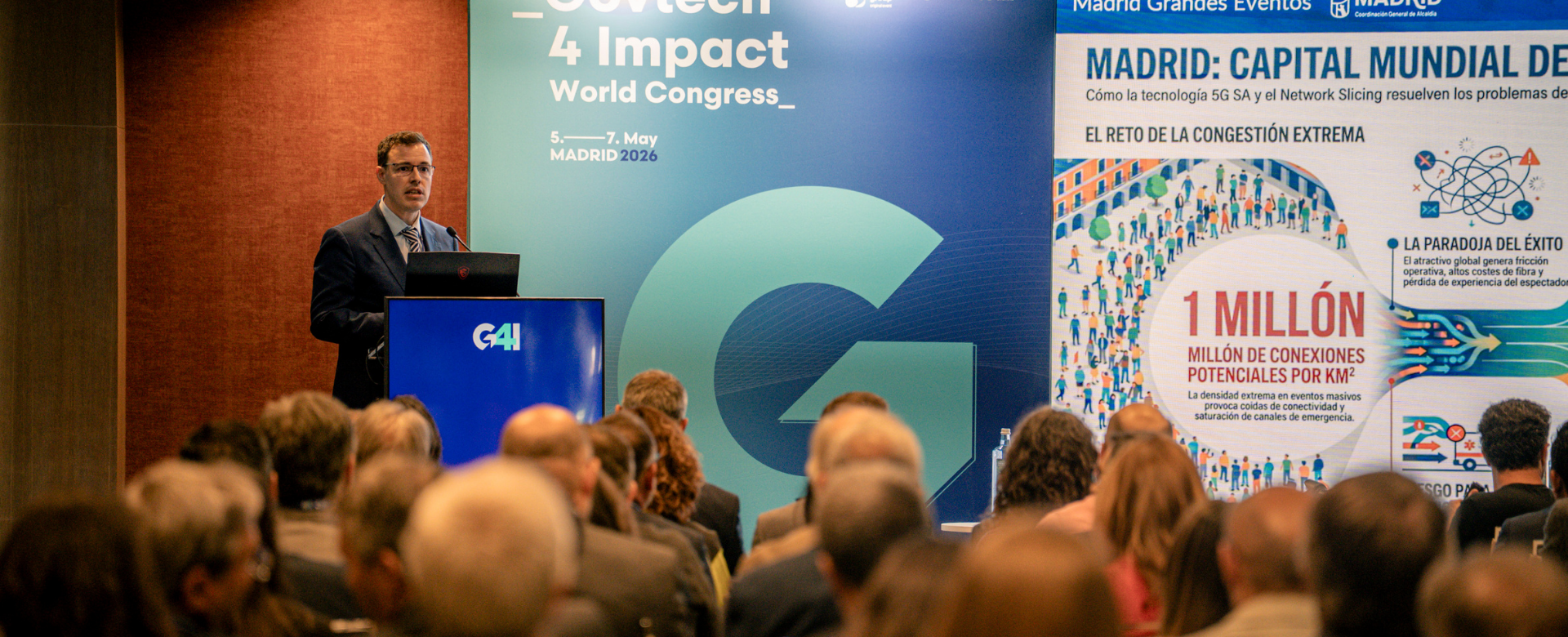
It is tempting to think of 5G as a faster way to stream video on a crowded street. The fifth session of Madrid’s 5G Forum, held on the Second Stage at the GovTech 4 Impact World Congress, set out to replace that idea with a more consequential one: 5G as the strategic infrastructure a city leans on precisely when everything else is under strain.
Convened by the City Council’s Digital Office, the forum framed Madrid in a double role: promoter and facilitator of a 5G ecosystem that brings together manufacturers, operators, integrators, universities, companies, and citizens. Fernando de Pablo, Director General of the Digital Office and G4I 2026 Expert Committee, placed 5G inside the city model Madrid is pursuing: a safe, connected, IoT-intensive city where urban data can be captured, processed, and used in real time. The day’s focus, he explained, would be the Madrid of major events: the Pope’s visit, Formula 1, future international competitions, all scenarios demanding robust communications, security, emergency coordination, and resilient infrastructure.
A connectivity base built for resilience
Javier Salamanca, STAM Ayuntamiento de Madrid, Telefónica Empresas, set out the network foundation, and the numbers were striking: 5G coverage close to 98% across the municipality, an advanced standalone 5G deployment, and an architecture deliberately reinforced after a national power blackout, with greater fibre redundancy and core nodes giving Madrid capabilities beyond the rest of the country. He emphasized edge computing – processing data close to where it is generated, as the enabler of real-time decisions during mass events and complex urban operations. The practical examples followed: live drone broadcasting at a golf event, the first video broadcast over a commercial 5G network at a major national sporting event, and immersive experiences with 360-degree vision and haptic accessibility for people with sensory disabilities at the Metropolitano stadium.
José Antonio Serrano, Head of Business Development, TOTEM, from the neutral-infrastructure operator perspective, focused on connecting high-density venues. He described a distributed antenna system with hundreds of antennas serving multiple operators at the Metropolitano, designed for a reality in which fans do not just consume content but generate intensive traffic – uploading video, going live, using club apps, even at peak congestion. The need, he argued, extends beyond the stadium’s interior to accesses, exteriors, and transport, and the lesson generalizes to hospitals, fairs, and emergency centres: continuity of experience requires specific radio design and infrastructure sharing.
Formula 1 as a laboratory
Mauricio Barroso, Gerente Soluciones Digitales & Servicios IT, Ifema Madrid, presented Formula 1 as an extreme and useful test bed, describing three layers of connectivity: a public 5G network to serve hundreds of thousands of attendees without the “stadium effect” of strong signal but no real capacity; a private 5G network with slicing dedicated to emergencies, operations, and production; and the organization’s own layer supporting international broadcast and real-time telemetry.
Each car, he noted, generates tens of thousands of signals per second. His analogy was pointed: just as Formula 1 has historically accelerated innovations later transferred to everyday use, much of the 5G applied to competition today will end up in field hospitals, health services, and smart cities.
When connectivity becomes a clinical tool
The most grounded interventions came from those responsible for emergencies. José Luis Hernández, Deputy Director Of Telecommunications, Ayuntamiento De Madrid, presented a plan to reinforce critical telecommunications through “resilience shields” for critical municipal sites: multiple fibres from different operators, 5G as backup, and satellite connectivity with automatic switching, so that venues such as security and emergency centres stay operational through multiple failures. The model extends to “shelters” in each district where staff and residents can remain connected during a crisis, and even to “personal shields” for key managers, with rapidly deployable connectivity “bubbles.”
Paloma Miravet González of SAMUR offered the session’s most clinical perspective through the Eugenia project, which restores 5G coverage in M-30 tunnels where navigation and communication systems otherwise fail, a loss that costs emergency teams critical minutes. She described three uses: reliable location in tunnels; clinical telemetry, allowing a unit to share electrocardiograms and vital signs with a coordinating center and receive immediate expert support; and real-time translation for patients who speak neither Spanish nor English. The benefits (shorter diagnostic times, second opinions on scene, better communication with hard-to-reach patients) have direct clinical impact. Javier Moreno Rebate, AAPP representative at MasOrange, added the mission-critical communications dimension, describing a private 5G network already in operational testing for firefighters, SAMUR, and police, including the first operational tactical “bubble” in Spain and a prioritization test during Madrid’s Christmas switch-on, where prioritised devices achieved speeds up to seven times higher.
Closing the day, Adrián Nogales, Director Of Institutional Relations, COIT, noted that in five years the forum has built a genuine space for collaboration between administration, university, operators, and companies. The overarching message was that 5G in Madrid is no longer understood as an incremental improvement in mobile connectivity, but as essential urban infrastructure for resilience, security, pre-hospital healthcare, and inter-institutional coordination: the backbone a city relies on when care and operational pressure are at their highest.
Key Takeaways
- 5G is critical infrastructure, not a consumer upgrade. Madrid frames it as the backbone for resilience, security, and emergency response — most valuable when the city is under the most pressure.
- Edge computing enables real-time decisions. Processing data close to where it is generated is what makes 5G useful for mass events, safety, and complex urban operations.
- Major events are laboratories. From Formula 1 to stadium connectivity, high-pressure events test mission-critical technologies that later transfer to healthcare and civil protection.
- Connectivity has direct clinical value. Restoring coverage in tunnels enables location, clinical telemetry, and real-time translation — shortening diagnostic times and improving emergency care.
- Resilience must be designed in advance. “Resilience shields,” redundant networks, and rapid-deployment connectivity ensure critical services stay operational through multiple failures.
The GovTech 4 Impact World Congress returns in 2027. To stay connected and be the first to hear about what comes next, visit g4i-congress.com and follow us on social media. #G4I2027
