Share this post on Social Media: A panel on sovereignty, cybersecurity, and geopolitical risk kept returning to a deceptively simple test: digital transformation only matters if it tangibly improves people’s lives. It would have been easy for a session titled “Fostering and Defending Digital Nations” to disappear into abstraction – sovereignty, cyber resilience, geopolitical risk, […]

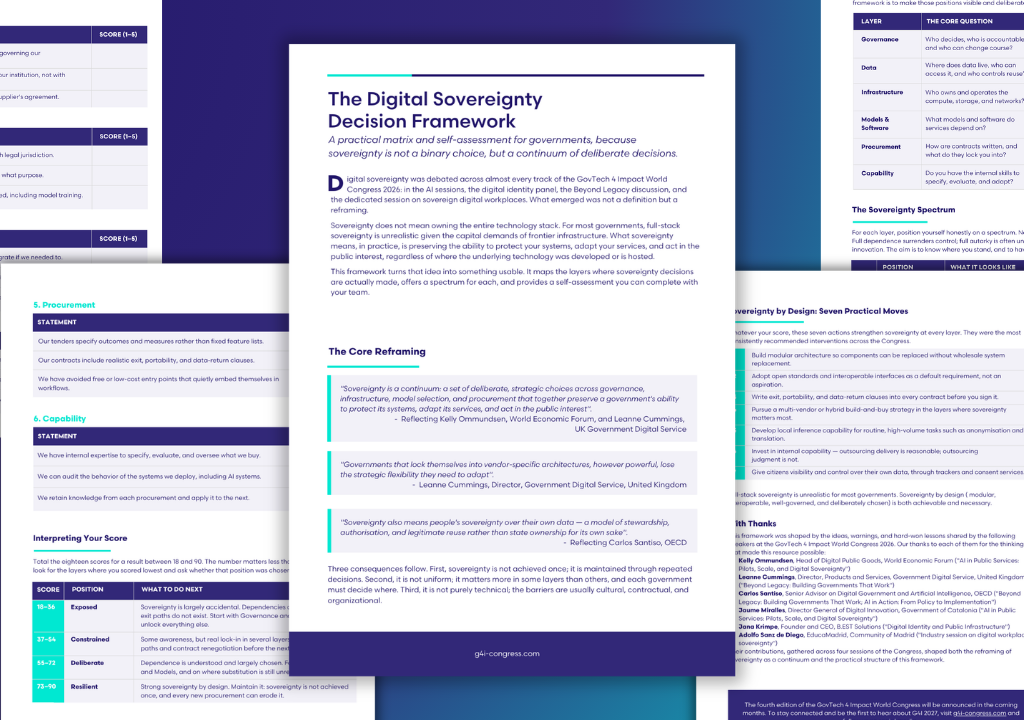
Sovereignty Is Not a Yes or No Question
Share this post on Social Media: Most governments debate digital sovereignty as though there were only two answers: own everything or surrender control. G4I 2026 offered a more useful way to think and a framework you can use. Ask a room of public officials whether their government has digital sovereignty and you will get an uncomfortable silence. Not because […]
The Invisible Backbone: How 5G Is Quietly Rewiring a City for Its Hardest Days
Share this post on Social Media: A Madrid city council made the case that next-generation connectivity is no longer a telecoms upgrade: it is critical public infrastructure for emergencies, major events, and the moments when a city is under the most pressure. It is tempting to think of 5G as a faster way to stream video on a crowded street. The […]
The Human Side of GovTech: Igor Lys on the Future of Governance
Share this post on Social Media: Image Source: @igorlys/LinkedIn The GovTech 4 Impact World Congress is coming this May and promises to be a central stage for GovTech innovation. As the event draws near, we had the opportunity to interview one of the key speakers for this year’s congress – Igor Lys, the Founder of […]
When the Government Disappears: Christine Bellamy on Trust in the Age of AI Agents
Share this post on Social Media: As citizens increasingly reach public services through commercial AI assistants, the UK’s digital chief asked an unsettling question: who gets the credit, and who keeps the accountability? The most provocative idea in this Main Stage fireside chat was not about what AI can do for government. It was about […]
10 GovTech Projects Worth Replicating
Share this post on Social Media: The best ideas in digital government are already built, tested, and working. They are just in someone else’s country. There is a peculiar kind of waste in the public sector. Somewhere in the world, a government has already solved the exact problem you are staring at: funded it, argued […]
Stop Starting with Ministries: A New Map for Where Government AI Actually Works
Share this post on Social Media: A landmark study presented in Madrid argued that the reason 40% of public-sector AI projects fail is structural — and offered a function-based way to fix it. Manuel Kilian came to the Main Stage with a number designed to focus attention. Roughly nine in ten citizens and businesses say they would […]
The Anchor Institutions Nobody Funds: Universities and the Future of GovTech
Share this post on Social Media: Everyone agrees universities are essential to public innovation. The harder question, raised during G4I 2026 is whether anyone is willing to pay for it. There is a comfortable consensus in GovTech circles that universities matter. They train talent, run the research, and incubate the start-ups that governments increasingly depend on. It is the kind of statement that […]
The GovTech Procurement Playbook: How to Stop Buying Problems
Share this post on Social Media: Procurement was the quiet protagonist of G4I 2026. Here is the practical wisdom from across the Congress, distilled into a checklist for your next tender. Plus a free downloadable guide! Ask anyone what derails digital transformation in government and they will probably reach for the obvious answers: legacy systems, skills shortages, risk-averse culture. Few will say […]
Move Fast Without Breaking Trust: Lessons from Madrid on Governing in the Age of AI
Share this post on Social Media: Taiwan’s first Digital Minister made the case that democratic deliberation isn’t too slow for the AI era – it may be the only thing fast enough to keep up. The conventional wisdom about government and technology goes like this: democracies are too slow, too cautious, and too consensus-bound to keep pace […]