
How Madrid Is Turning Digital Innovation into Better Public Services
At GovTech 4 Impact World Congress, Madrid City Council pulled back the curtain on digital transformation in action, showcasing eight projects that are helping the city tackle housing, civic participation, loneliness, employment, urban planning, and mobility. Together, they revealed a simple but powerful principle: if innovation doesn’t improve everyday life for residents, it isn’t innovation at all.
Digital transformation strategies often sound impressive on paper.
AI. Digital twins. Predictive analytics. Smart cities.
The real challenge begins when those concepts have to solve actual problems for actual people.
That was the premise behind Madrid City Council’s Second Stage session at GovTech 4 Impact World Congress. Rather than discussing strategy in abstract terms, city leaders presented a selection of projects already being deployed across the city, offering a practical look at how technology is reshaping public services.
The common thread running through every presentation was remarkably simple: digital government should start with people, not technology.
As Marta Cruz Rojo, Head of Service for Madrid Capital Digital, explained, Madrid’s transformation strategy is built around two priorities: delivering better digital services for residents and creating collective intelligence that helps the city make better decisions. Technology is the enabler, but people remain the focus.
Solving Everyday Problems, One Service at a Time
One of the clearest examples came from housing and urban development.
Marta Parro Pérez, Head of Coordination and Innovation Service for Licences, General Directorate of Building, presented Madrid’s new digital building permit platform, designed to dramatically reduce approval times by transforming how permit applications are submitted and reviewed.
Rather than relying on traditional documentation, applicants will submit structured BIM (Building Information Modelling) files that allow the system to automatically validate information and identify compliance issues before human review begins.
The goal is ambitious: reducing permit timelines from more than two years to approximately six months.
But perhaps the most important lesson was not about AI at all.
As Parro Pérez highlighted, automation starts with clean, structured, machine-readable information. Successful digital transformation often begins long before algorithms enter the picture.
Turning Citizen Participation into Action
Another project demonstrated how digital tools can strengthen the relationship between governments and citizens.
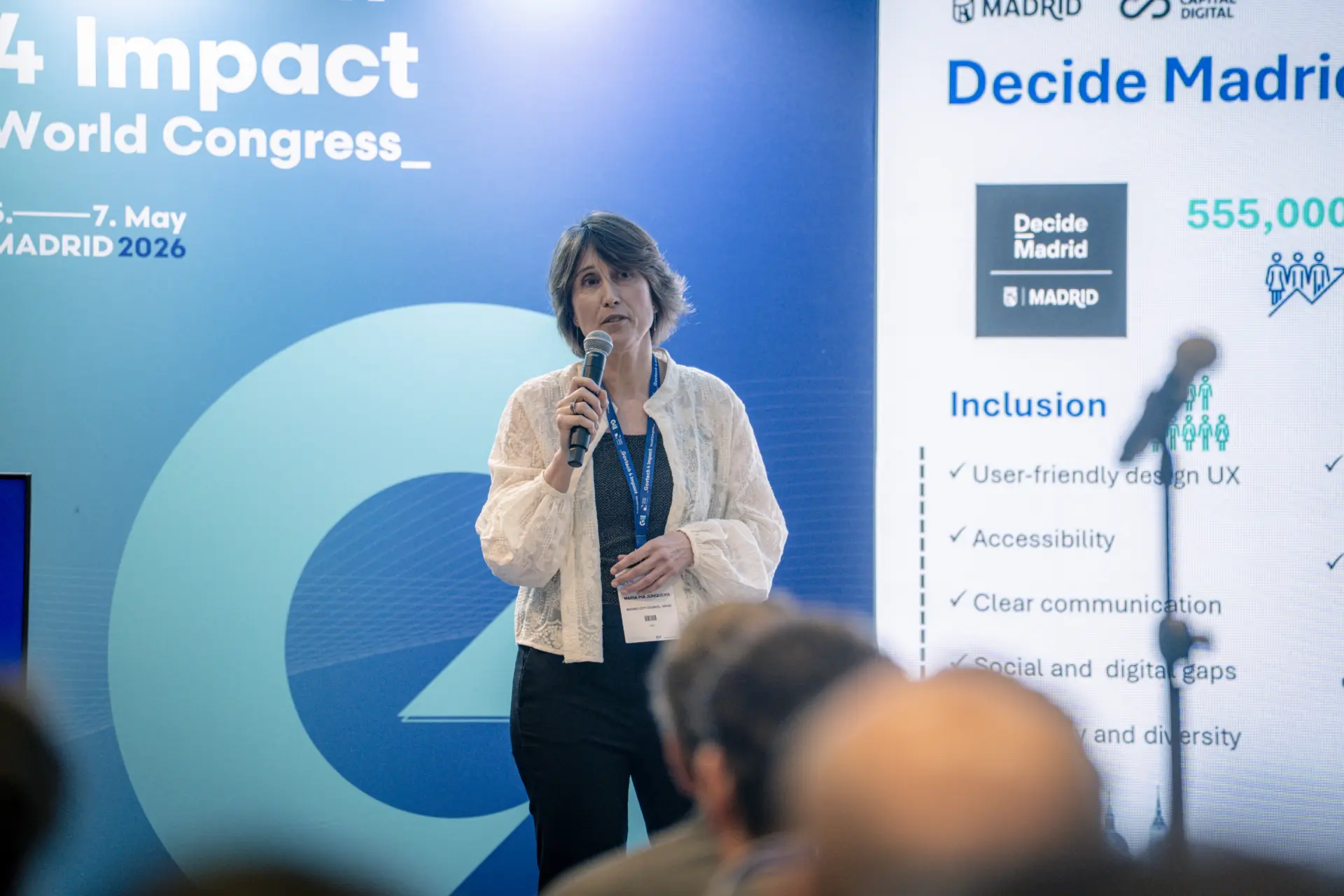
María Pía Junquera, Director General for Citizen Participation, Madrid City Council, shared the evolution of Decide Madrid, one of Europe’s most established civic participation platforms. With hundreds of thousands of citizens taking part in consultations, commenting on proposals, and contributing to participatory budgeting initiatives, the platform has become far more than a digital suggestion box.
What makes the initiative significant is its focus on impact.
Through a combination of accessibility initiatives, outreach programs, and data-driven analysis, citizen input is helping shape real investment decisions and public policies across the city.
The message was clear: participation only builds trust when citizens can see tangible outcomes from their contributions.
Can AI Help Address Loneliness?
Perhaps the most human story of the session came from José Manuel Ropero, Deputy Director General for Older People and Unwanted Loneliness, Madrid City Council, who introduced Paloma, Madrid’s AI-supported program designed to identify and address loneliness among older adults.
The initiative responds to a growing challenge in a city where more than 700,000 residents are over the age of 65, with many living alone.
Paloma’s first phase combined outreach and screening to identify individuals who might be experiencing social isolation. Those requiring support were connected with professional psychologists and human-led services.
The newest version expands on that approach by using AI to help identify risk levels, recommend activities, and maintain ongoing engagement.
Yet throughout the presentation, one message remained non-negotiable: AI supports care, but it does not replace human care.
The program demonstrates how technology can help public services scale without losing their humanity.

Designing Services Around Citizens, Not Institutions
This principle also shaped the city’s approach to employment services.
Miguel Ángel Alemany, Deputy Director for Active Employment Policies, Employment Agency, Madrid City Council, presented SALTA, Madrid’s Employment Agency platform, which reorganizes services around the job seeker’s journey rather than the agency’s internal structure.
AI helps automate administrative tasks, reduce repetitive data entry, and better match individuals with employment and training opportunities. However, decision-making remains subject to human oversight.
The project’s broader significance lies in its design philosophy.
Instead of asking citizens to navigate government structures, the service adapts to citizens’ needs.
It is a subtle shift, but one that increasingly defines successful digital government.
Building the Digital Foundations of the City
Behind many of Madrid’s initiatives is a growing digital infrastructure that helps the government understand and manage the city in real time.
Jesús Cerezo, Head of Process Integration Service, Deputy Directorate General for Urban Innovation and Information, highlighted Madrid’s expanding geospatial ecosystem, which has evolved from historic aerial photography archives into a sophisticated platform comprising approximately 1,000 datasets and serving thousands of users every day.
The city’s Geoportal supports a wide range of use cases, from analyzing urban greenery to modelling underground infrastructure and supporting long-term planning decisions.
At the same time, Javier Morales Puerta, Technical Adviser, Sueña Project, showcased how Madrid is reimagining urban planning itself.
Traditional planning processes can take years to develop and approve. Madrid’s new approach introduces the concept of “4D urbanism,” using real-time data and predictive models to make planning more adaptive and responsive.
A Strategic City Simulator, built using dozens of public data sources and indicators, enables planners to evaluate different scenarios and explore how policy decisions may affect the city over time.
The result is a more dynamic approach to governing a rapidly changing urban environment.
From Managing Traffic to Managing Mobility
Transportation offered another glimpse into the future of public services.
José Javier Rodríguez, Deputy Director for Traffic Regulation and Taxi Services, Madrid City Council, described Madrid’s efforts to use AI and computer vision to improve how traffic signals respond to real-world conditions.
But the project begins with a change in perspective.
The objective is no longer simply to manage vehicles. It is to manage mobility.
Using video analytics, the city can detect pedestrians, understand movement patterns, and adapt crossings when conditions change. For example, traffic-light timing can be adjusted when large crowds leave a football stadium or when pedestrians require additional time to cross safely.
Rodríguez was refreshingly realistic about the challenges involved.
AI systems are imperfect. Performance varies across environments, lighting conditions, and contexts. In safety-critical situations, human oversight and fallback systems remain essential.
That honesty reflected a recurring theme throughout the session: successful AI implementation requires discipline, governance, and a clear understanding of where technology adds value.
The Agentic City Starts with Citizens
Closing the session, Carlos Acha Ledesma, Director of Technology and Innovation of EMT Madrid, offered a broader perspective on the future of urban innovation.
He described a progression from data collection to predictive analytics and ultimately to AI-powered operational decision-making across transport and mobility systems.
Yet his strongest message was not about technology.
It was about purpose.
Digital transformation should create public value. It should improve accessibility, sustainability, equity, safety, and quality of life.
In other words, innovation should be measured by outcomes, not by novelty.
That philosophy aligns closely with Madrid’s vision of the “agentic city” — a city where technology helps institutions act more effectively on behalf of citizens.
Key Takeaways
- Start with the problem, not the technology – Across every project, Madrid focused first on solving real challenges such as housing delays, social isolation, employment access, and mobility. Technology was the tool, not the objective.
- Clean data is the foundation of transformation – As Marta Parro Pérez demonstrated with the digital permits platform, meaningful automation requires structured data, clear processes, and strong information management before AI can deliver results.
- Participation creates value when it drives action – María Pía Junquera’s Decide Madrid initiative showed that citizen engagement is most effective when it directly influences policies, investments, and decision-making.
- AI works best when paired with human expertise – From Paloma’s loneliness programme to traffic management systems, Madrid’s projects consistently used AI to support human decision-making rather than replace it.
- The ultimate test is the citizen experience – Whether improving housing delivery, helping older adults, supporting job seekers, or making streets safer, every initiative was evaluated against the same standard: does it make life better for residents?
Read more from our Insights Hub...

Who Controls Your Identity in a Digital World?
Share this post on Social Media: At GovTech 4 Impact World Congress, leaders...
Read Article →
Stop Starting with Ministries: A New Map for Where Government AI Actually Works
Share this post on Social Media: A landmark study presented in Madrid argued...
Read Article →
Connecting Technology to Public Value:A Conversation with Estonia’s Government CDO Ott Velsberg
Share this post on Social Media: Image Source: @ott-velsberg/LinkedIn The GovTech 4 Impact...
Read Article →