Tourism & Design: A Strategic Strength for the Future
In collaboration with Design Institute Of Spain
Tourism & Design: A Strategic Strength for the Future
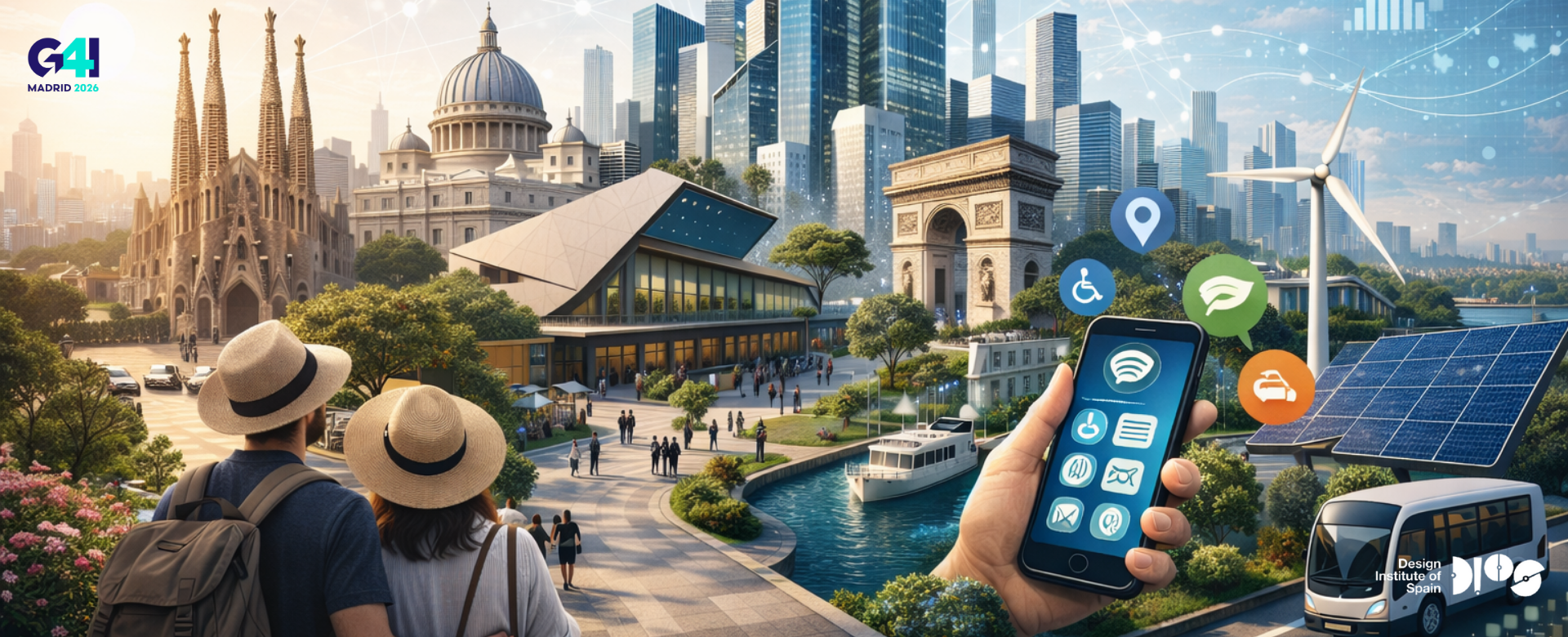
DIOS is pleased to be collaborating with the Govtech 4 Impact World Congress 2026, happening on 5-7 May 2026 in Madrid, Spain. The Govtech 4 Impact World Congress (G4I) is a global, high-level forum focused on the digital transformation of governments, where technology meets public service and governance. This is the third edition of the forum and will gather government leaders actively driving transformation in their sectors.
For decades, tourism was understood mainly as a service industry: hospitality, transport, information and infrastructure. Tourism is no longer an economic activity, it is a real time stress test of city governance. However, the transformation of cities, the digitalisation of daily life, the pursuit of meaningful experiences, and the growing sensitivity toward inclusion and sustainability have radically changed the landscape. Today, tourism is not only managed, it is designed, giving room to one of the biggest strengths for the future of the sector, “Creative Tourism”.
The synergy between tourism and design may sound complex, yet it is as simple as it is powerful. The experiences we remember are not only visual but emotional, shaped by how we live them. Design, in its broadest sense, urban, architectural, digital, sensory and inclusive, is the language that shapes experience. It is the tool that transforms a service into emotion, a space into identity, and a city into a story.
The world’s most iconic tourist cities share a common characteristic. They treat urban design as an integral part of their tourism strategy and cultural identity, amplifying both good and bad design choices. Tourists use transport, public space, healthcare or culture to immerse themselves into a city environment. Streets, lighting, clear directions for ease of movement and even landscapes are designed not only for residents but also for visitors. Contemporary tourism is both an aesthetic and emotional act, and design is the formula that makes it possible.
Urban design influences the quality of life of residents as much as the quality of experience for travellers. A well-designed neighbourhood invites people to walk, discover and stay. A well-designed museum does not just house culture; it amplifies it. A well-designed hotel does not simply host, it tells a story. Thus, design becomes economic, cultural and symbolic value.
Tourism and design are not add-ons to city innovation.
They are powerful accelerators of technology-driven governance, citizen trust and sustainable urban development.
Recent research in tourism and experience design shows that the true differentiating value lies not only in the product but in the designed experience. Marc Hassenzahl and other scholars of Experience Design argue that memorable moments emerge when function and emotion align. In tourism, this translates into breathtaking itineraries that exceed local expectations, moments of genuine connection and micro-experiences that combine space and narrative.
Experience-oriented design enables the creation of surprising urban tours, exciting hotel services, technologies that are not intrusive and environments that generate well-being. In a global market saturated with options, the design experience is the real competitive advantage.
In today’s world, technology is a powerful ally, but by itself it does not transform tourism. It is design and intention that make technology meaningful. A smart city is one that utilises technology to enhance the human experience, to orient, connect, interpret and facilitate. Digital design, including apps, virtual reality, intelligent signage and service interfaces, has become a decisive part of the tourist journey. Hotel reservations, ticket purchases, neighbourhood exploration and interaction with cultural heritage are already part of the digital travel experience. Design is often misunderstood as aesthetics. In GovTech terms, design equals usability of government.
When technology is well designed, it disappears.
It becomes intuitive and natural. That is where the tourism and design synergy reaches its greatest potential.
Inclusion is no longer a regulatory obligation; it has become a driver of innovation and competitiveness. Universal design makes it possible to create experiences that work for all.
Accessibility is not only a right. It is a growing market, a quality standard and a source of reputational value. Inclusive design is, therefore, a strategic strength for the future of tourism.
At the same time, sustainability is now a mandatory criterion and increasingly decisive in contemporary urban and architectural development. Culture, conservation, commerce and care for the local community are fundamental pillars of this tourism and design synergy.
Recent studies on “design orientation” in tourism and commercial enterprises confirm this. Integrating design into strategy increases performance, differentiation and loyalty. Design is not cosmetic; it is a management tool, an innovation catalyst and an identity generator.
Tourism accelerates innovation because cities must manage peaks, flows and diversity. Tech areas where tourism pushes GovTech forward include data and AI, digital identity and access, mobility and sustainability, and safety and resilience.
An important topic that will be discussed at the Govtech 4 Impact World Congress is how tourism and design, within technology-driven governance, could be considered not as “soft sectors” but as strategic urban systems.
Design not only renews what exists; it shapes what is to come.