Digital Transformation
& Public Services:
Turning Crisis
into Opportunity
with Tamara Srzentić
and Mikey Dickerson
Digital Transformation & Public Services: Turning Crisis into Opportunity
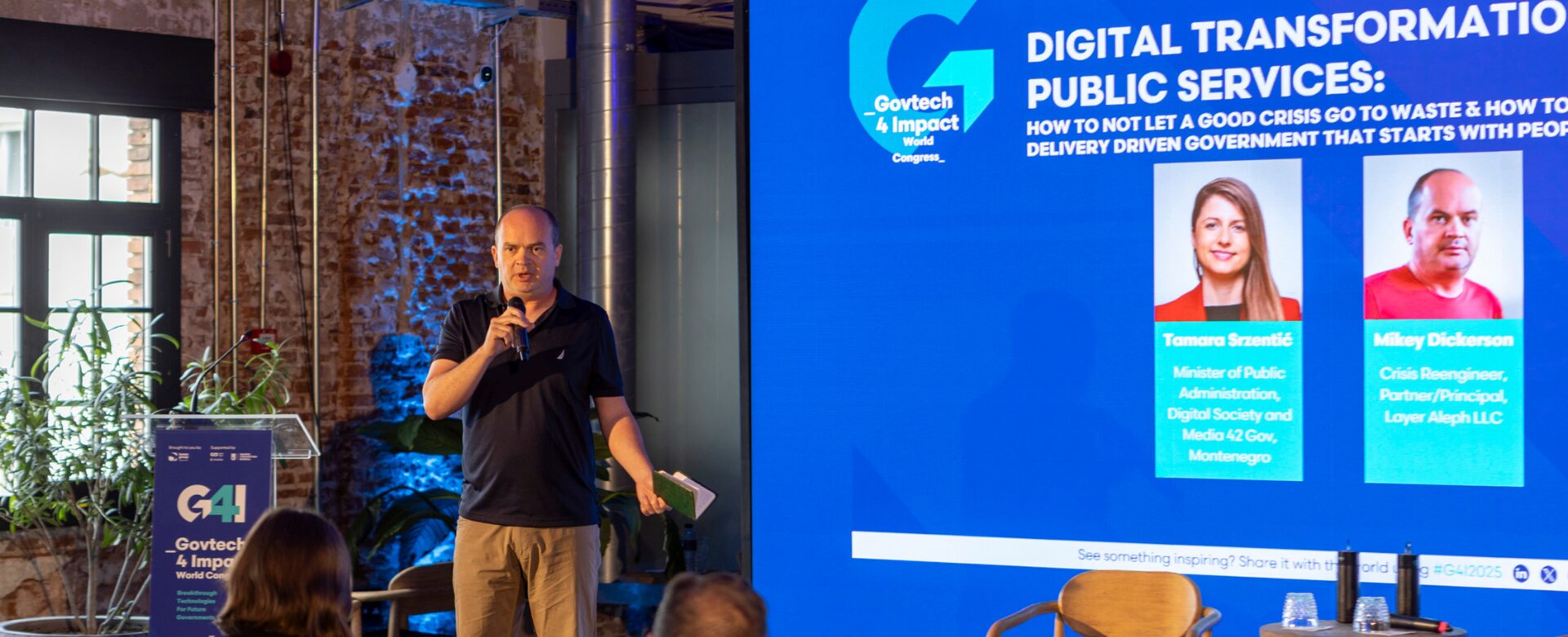
At GovTech 4 Impact World Congress (G4I) 2025, a powerful keynote session explored how governments can leverage crises to accelerate digital transformation and deliver public services that truly prioritize people. Under the thought-provoking theme “Digital Transformation & Public Services: How to not let a good crisis go to waste & how to build a delivery-driven government that starts with people,” two visionary leaders shared insights from their extensive global experiences:
- Tamara Srzentić, Minister of Public Administration, Digital Society, and Media, 42nd Government of Montenegro
- Mikey Dickerson, Crisis Reengineer, Partner/Principal, Layer Aleph LLC; former head of the U.S. Digital Service
Moderating and adding context, they provided a compelling case for reimagining the role of government through human-centered innovation, emphasizing the transformative potential hidden within moments of disruption.
Tamara reminded the audience that, across every government she has served – from California to Montenegro, the real obstacles were rarely tech related. Her rich experience spans leading high stakes, nationwide reforms, most recently serving as a Minister of Public Administration Digital Transformation and Media of Montenegro. Under Governor Newsom, Tamara and her teams led digital service and open gov reforms, and were charged with leading California’s pandemic digital response.

Technology is usually the easy part
The harder work lives in culture, trust, and helping people inside our institutions work differently. Time and again, the breakdowns weren’t missing platforms or tools, but outdated processes, unclear incentives, fractured communication, and public servants being asked to deliver ambitious outcomes inside systems never designed for learning or collaboration: “And yet, they [public servants] keep showing up. Quietly. Steadily. They hold the line with full hearts, hard hope, and a moral ambition that rarely makes headlines – but it absolutely should.”
Tamara spoke about how, when teams are finally given room to rethink procedures, clarify roles, and create real channels for feedback, the impact is immediate. “Services improve. Decisions accelerate. And .. perhaps most importantly .. public servants rediscover confidence in their own ability to deliver.”
She emphasized that transformation has never been about a single hero. #ItTakesaVillage Leadership in government is extraordinarily hard: coordinating across silos, building trust, and making change without direct authority. So instead of asking public servants to be heroes, Tamara challenged us to build cultures and systems that make courageous leadership possible.
For decades, leadership debt, outdated mindsets, risk-averse habits, and fear-based decision-making, has drained morale and pushed talent away. Tamara called for more “WE vs I” leaders: who don’t issue directives from the top, but co-create outcomes with the public and values with their teams; who foster psychological safety; align incentives with purpose; remove barriers, offer air cover, and ensure that courage is not punished but cultivated.”
The role of leadership, she said, is to create these conditions. Not heroics and optics. Not command-and-control. But systems that allow perspectives and superpowers to surface from every corner of the organization.
These kinds of leaders:
- sweat the small stuff that actually matters, thinking differently about how time is spent and how roles are conceived;
- are unafraid to confront entrenched bureaucracy, knowing that outcomes won’t magically emerge from planting new policies in a broken soil;
- focus on outcomes, not optics, understanding that progress in government rarely makes headlines -it is built by debugging the machinery one bit at a time, reinforcing new behaviors, and making sure systems support the people they exist to serve.
“The real challenge is human” Tamara stressed that this is exactly why governments must be careful not to treat new tech, especially AI .. as a silver bullet. “When you have a hammer, everything starts to look like a nail,” she said. And in the rush to adopt the newest AI tools (without understanding the problem they are trying to solve), many governments risk layering AI on top of broken systems, unclear policies, outdated incentives, or bad data hygiene. Without this delivery capacity and practices rooted in testing and learning / data, research and design – advanced tech will only amplify existing calcified bureocracy. She argued that “the future of government depends on repeatable systems that connect human needs and public purpose to delivery …every day, at every level”
Mikey Dickerson: Crisis as a Moment of Organizational Rebirth
Mikey Dickerson challenged the audience to reconsider how crises serve as crucial turning points for organizational change. His core message: “No one else is coming – we must do it ourselves.”
Drawing from his extensive experience at Google, the Obama Administration, and advising numerous U.S. states, Mikey shared that organizational readiness for transformation is rarely about technical skill or individual effort alone. “It’s not about how smart or hard-working you are, but whether conditions within an organization are receptive to change,” he explained.
He emphasized the paradox of government projects, noting that truly impactful digital transformations remain disappointingly rare. Yet, these critical breakthroughs often occur precisely during moments of intense disruption, when traditional methods fail, forcing organizations to adapt or collapse.
Using the dramatic example of HealthCare.gov, Mikey illustrated how crises can redefine institutional identity, compelling governments to transition from outdated models into user-centered, agile entities. He highlighted the vital role of storytelling in this transformation: “Effective storytelling reprograms the identity of organizations, shifting them from inertia toward innovation.”
Mikey concluded with unexpected, powerful advice: “Work on yourself first. Physically, emotionally – build your resilience now. When the crisis comes, you’ll be the source of adaptability. Machines can’t do it. It has to come from you.”
Key Lessons and Calls to Action:
- Leverage Crisis: Crises are not just challenges – they’re rare opportunities to drive rapid, meaningful change.
- Human-Centric Leadership: True transformation prioritizes people, empathy, and understanding underlying human needs.
- Build Internal Capacity: Governments must invest in talent, especially human-centric skills, not just technology.
- Storytelling as Strategy: Clear, compelling narratives facilitate organizational readiness and adoption of new ways of working.
- Cultivate Resilience: Sustainable transformation demands leaders who are physically and mentally prepared for disruptive moments.
The keynote session left participants inspired, recognizing that the path to impactful digital governance lies not just in technology, but fundamentally in empathetic, adaptive leadership grounded in understanding the human experience.
At G4I 2025, Tamara and Mikey’s powerful narratives reminded everyone: effective government in the digital age begins and ends with people.