
The City Brain That Shouldn’t Become Another Silo
A Second Stage panel cut through the hype around “city brains” to a harder truth – the hardest part is not the technology, but getting a city’s departments to share, trust, and coordinate.
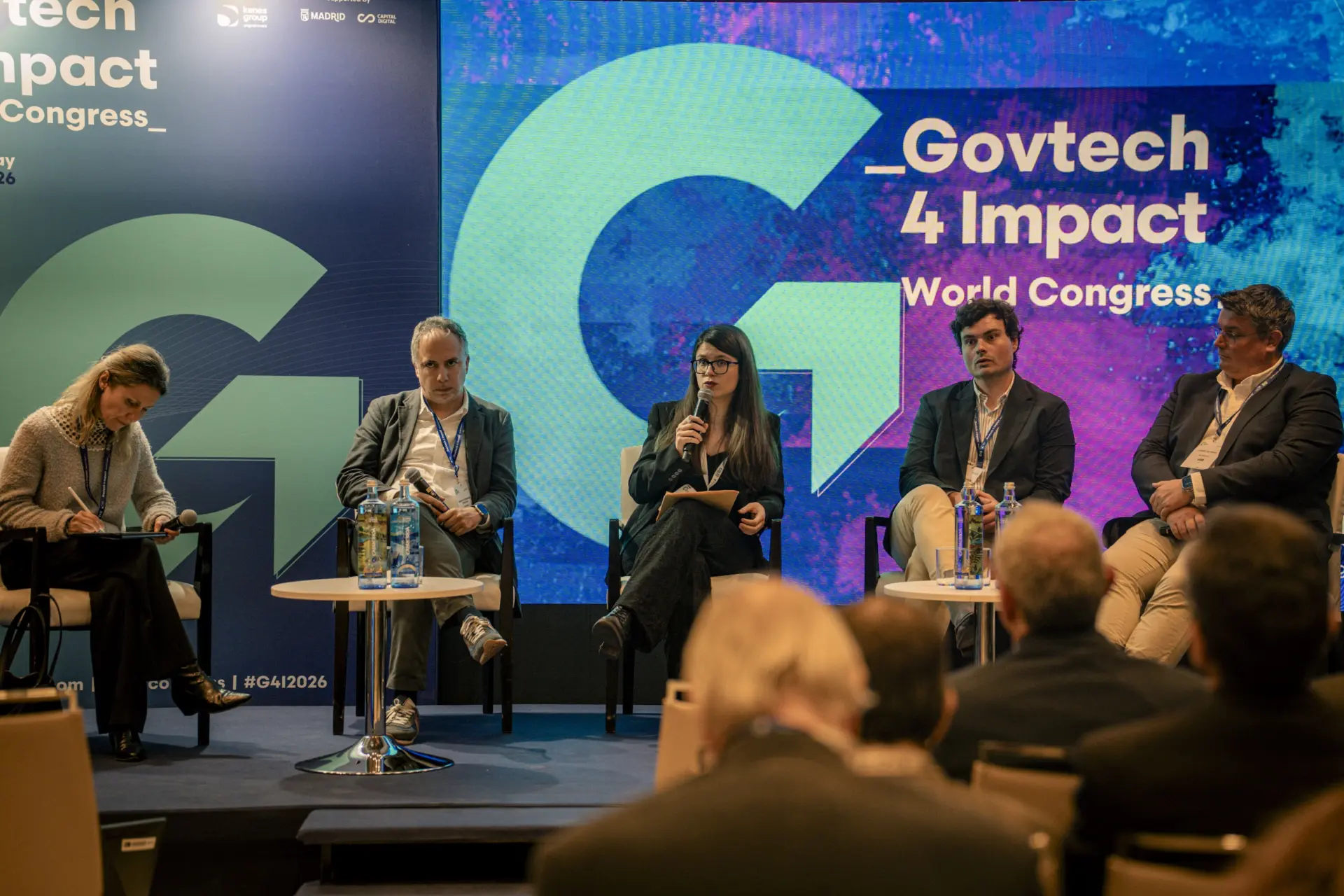
“City brain” is the kind of phrase that promises more than it explains. The panel that gathered on the Second Stage during the Govtech 4 Impact World Congress 2026 “Panel Session: Collective and Cognitive Urban Intelligence: City Brains in Action”, moderated by Cristina San Juan, Head of Digital Services at Arup Spain, spent its time deflating the grandiosity and rebuilding something more useful in its place: not a single command center that runs the city, but an orchestration layer that connects what already exists.
Christina San Juan set the context precisely. Many large cities already operate mature control centers for traffic, emergencies, security, and infrastructure. The problem is not the absence of operational rooms, it is the lack of connection between them. Cities behave as interconnected systems, so a disruption in one sector cascades into others. The real question was how to create a shared, city-wide operational picture without building yet another silo.
Four Layers, And A Controversial Term
Marta Cruz, Head of Digital Intelligence Service, Madrid City Council, was candid that the very concept remains immature, and the terminology contested. She described Madrid’s approach as an evolution from traditional smart-city thinking toward “collective intelligence” – using data to improve decisions and adapt services in real time. She outlined a conceptual architecture of four layers: smart urban spaces, the digital twin, the city brain, and data spaces. In this model, the city brain is not the whole system but one building block, intended to identify important events in real time and give officials better awareness for decision-making.

Arturo Malagón, Head of Digital Services, MasOrange, reinforced the importance of real-time data and described the city brain as a major operational challenge rather than a software product. From the telecommunications perspective, he highlighted processing anonymized telco data in real time to understand city dynamics without sensorising every street — stressing that the value lies not in collecting data but in making it timely and operationally useful.
Corné Helemons, Advisor Digital Twin, GeoBIM and Standardisation, Municipality of Rotterdam, explained that Rotterdam does not use the term “city brain” at all, but is building an ecosystem of applications that serve a similar purpose – bringing municipal and external data services together, connecting them to analytics platforms for use cases like traffic forecasting and rainfall impact prediction, and visualizing outputs through dashboards and digital twins. He was explicit that such systems should not make decisions for the city; they should aggregate data and insight so that qualified people can decide better and faster.
Roberto Fernández-Hergueta, Digital Innovation & Public Sector Specialist, Madrid, characterized the city brain as an orchestration mechanism rather than a control mechanism, aligning with the panel’s consensus against building a new “super” command center. Using the brain metaphor, he argued that before building a brain, cities must understand the “body” — their assets, systems, data quality, and foundational architecture — and that the city brain is best understood as an operational data layer for the digital twin that adds value to existing command centers rather than replacing them.
How To Avoid Building A New Silo
The sharpest part of the discussion was the shared fear that a city brain could become just another disconnected dashboard. Marta Cruz called this one of the greatest challenges in Madrid’s work, and stressed it is not primarily a technological issue but an organizational one. Madrid has tried to address it through interoperability and transferability from the outset, building a proof of concept and, crucially, spending real effort visiting city support centers to understand what would actually be useful to operational teams. Those departments, she insisted, are the true protagonists; if they are expected to share data, they need a clear answer to why sharing matters and what value they receive in return.
Helemons described Rotterdam’s response as governance by architecture: starting with a vision for interoperability and scalability, translated into an enterprise architecture with explicit agreements that every innovation project must comply with, including open standards and an open platform where data services and applications can be registered and connected via APIs. Malagón added a functional warning, such an initiative cannot be driven by ego or ownership instincts. If the city brain is treated as the property of one department or viewpoint, it is “dead from the start.” Fernández-Hergueta added that governance and legal frameworks remain decisive even when the technology is available, cautioning against the temptation to see the city brain merely as a live reporting tool for the mayor.
The Mistakes Cities Keep Making
Asked about common mistakes, the panel was refreshingly concrete. Fernández-Hergueta warned against building advanced shared intelligence without first modelling the city’s underlying systems, emphasizing the need for common ontologies and semantic models – a “digital Esperanto”, without which cities risk a Babel where systems cannot interoperate no matter how sophisticated the dashboards. Helemons stressed that cities cannot do this alone, since assets and data are distributed across many authorities, and that even a city the size of Rotterdam is too small to sustain every innovation internally – making national and international collaboration essential to attract vendors.
Malagón identified two especially common mistakes: lacking a clear long-term vision and chasing fashionable technologies, which leads to multiplying platforms until a city ends up with what he memorably called a “million-dollar nothing”; and failing to understand the purpose of data, wanting dashboards and KPIs for optics rather than operational improvement. Marta Cruz agreed that many mistakes have already been made and should now become shared lessons, pointing to collaboration at every level – within the digital office, across departments, with partners, and with other cities – as the answer.
San Juan’s synthesis captured the session. What began as a discussion about a concept had become a discussion about a much larger transformation journey. City intelligence is not just about technology; it requires data sharing, ecosystem partnerships, governance, institutional trust, and change management. Implementing the technology, she noted, is relatively straightforward compared with implementing organizational and cultural change across a city. The city brain, in the end, is not a finished product but an emerging operational and governance model – one that should support coordination rather than centralize control, enhance existing operations rather than replace them, and be grounded in real use cases defined jointly with the people who run the city day to day.
Key Takeaways
- A city brain orchestrates – it does not control. The goal is to connect existing control centres into a shared operational picture, not to build a new super command center.
- Understand the “body” before building the “brain.” Cities must first model their assets, systems, and data quality; the city brain is an operational layer on the digital twin, not a replacement for it.
- The hardest challenge is organizational, not technical. Departments are the true protagonists – they will only share data if they understand why it matters and what value they get back.
- Avoid the “million-dollar nothing.” Chasing fashionable technology without a clear vision or a real purpose for data leads to multiplying platforms that deliver no operational value.
- Semantic consistency is essential. Without common ontologies – a “digital Esperanto”, and public-private collaboration, systems cannot interoperate however sophisticated the dashboards appear.
Read more from our Insights Hub...
Sovereignty Is Not a Yes or No Question
Share this post on Social Media: Most governments debate digital sovereignty as though...
Read Article →
Smart Isn’t Smart If It Doesn’t Work for Everyone: Defending the Digital Nation
Share this post on Social Media: A panel on sovereignty, cybersecurity, and geopolitical...
Read Article →
Stop Starting with Ministries: A New Map for Where Government AI Actually Works
Share this post on Social Media: A landmark study presented in Madrid argued...
Read Article →